
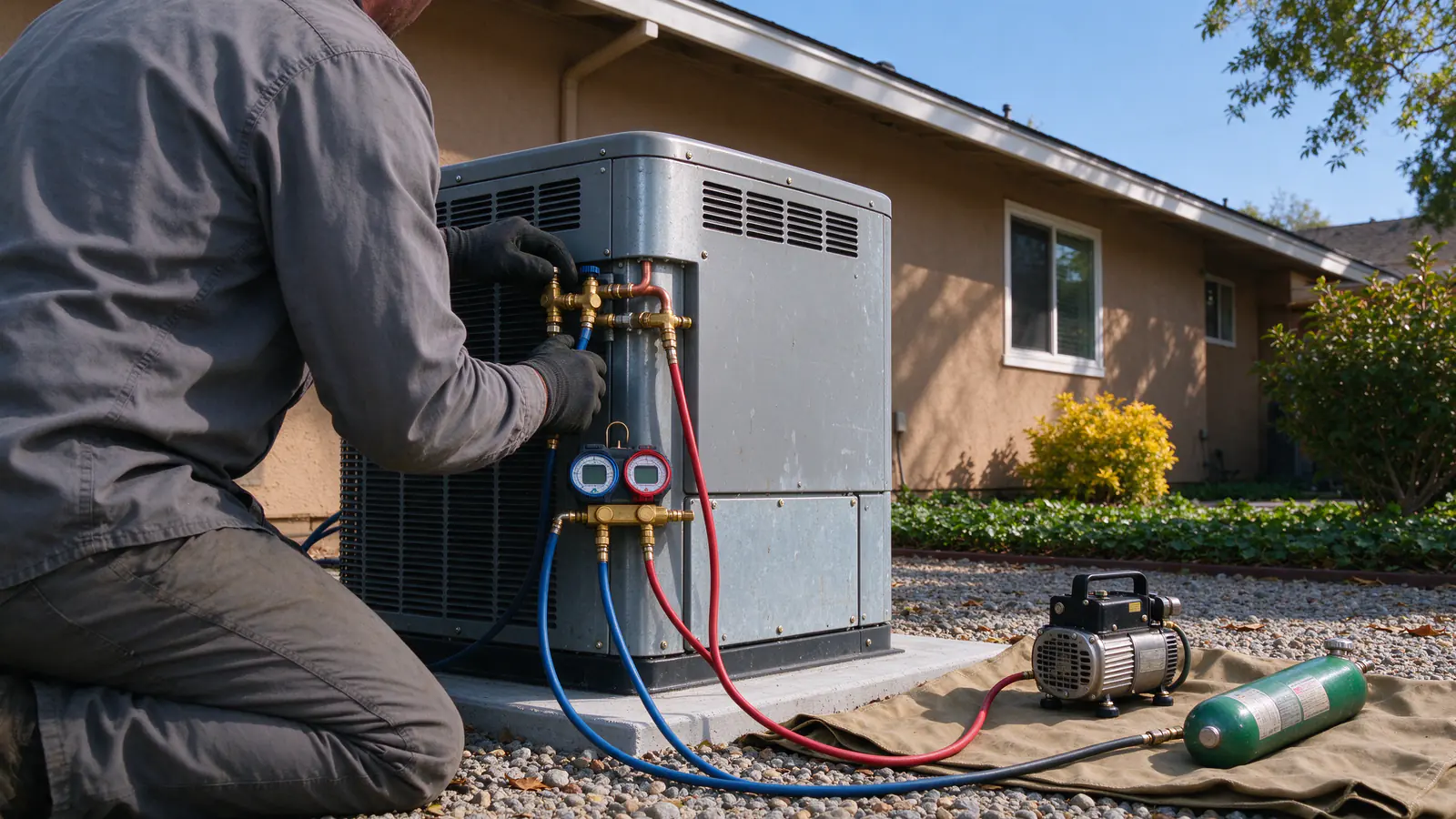
Picture a single-story Sacramento-area house with a gas furnace in the garage, a central air conditioner on a pad by the side fence and ducts in the attic. Both pieces of equipment are old enough that the owners want to replace them together, and they want one electric system instead of two. This walkthrough follows that kind of project from the first visit to the day the inspector signs off.
Who plans and does the work
Tule Sacramento Heat Pump plans and installs gas furnace to heat pump conversions across the Sacramento region, with the work carried out by licensed and insured contractors (C-20 for HVAC, and C-10 for any panel work). The steps below follow how those contractors run a conversion; the gas furnace to heat pump conversion page covers the service itself.
Before the day: the first visit
What gets measured
The first visit is where most of the decisions are made, so it takes longer than a quick look at the old equipment. In this kind of house it covers:
- System ages and model plates for the furnace, the coil on top of it and the outdoor condenser.
- A Manual J load calculation for the house (the sizing guide explains why), because the old furnace and the old air conditioner were rarely sized to the same load.
- A duct and static-pressure check to see whether the existing ducts can carry the airflow a heat pump needs. Title 24 sets a minimum of 300 cfm per ton for the refrigerant charge check, and heat pump ductwork covers what happens when the ducts fall short.
- The electrical panel, its size and its open spaces, since the heat pump circuit and any backup heat strips need room.
- The outdoor location, whether the new unit can sit where the condenser did, with clearance and drainage.
- The utility. SMUD, Roseville Electric or PG&E changes both the running cost and which rebate applies.
What the quote then shows
From those findings the quote names the equipment, the capacity, any duct sealing or replacement, any electrical work and how backup heat will be handled. If the owners are SMUD customers and want the heat pump rebate, the quote also says that qualifying equipment will be installed by a participating contractor in the SMUD Contractor Network. The quote comparison guide lists what a complete quote should spell out, and the conversion cost guide explains the price ranges.
The permit comes first
Every installed heat pump in California needs a building permit. Inside the City of Sacramento a one- or two-family change-out goes through the online minor permit, and the standard web permit assumes the new unit goes in the same spot and is no more than 25% larger than the old one.
In unincorporated Sacramento County, which includes Carmichael, Fair Oaks and Arden-Arcade, a residential heating and cooling permit is applied for online and issued once paid. A panel upgrade needs its own electrical permit. The permit and Title 24 guide covers each office.
Install day, in order
Morning: the old system comes out
- Refrigerant recovery. The refrigerant in the old air conditioner is recovered into a cylinder, not vented.
- Gas shutoff. The gas branch to the furnace is shut off and capped, and the old flue opening is closed off so it cannot leak air or let water in.
- Removal. The furnace, its coil and the old condenser come out, and the electrical supply to the old equipment is made safe.
Midday: the new system goes in
- Set. The air handler goes where the furnace stood, connected to the existing supply and return plenums or new ones. The outdoor unit is set on a level pad that drains defrost water away from the foundation.
- Braze. The refrigerant lines are brazed at both ends. If the old line set is the wrong size or in poor condition, it is replaced rather than reused.
- Electrical. The outdoor unit gets its disconnect and circuit, and the air handler its supply. Panel work, if the quote included it, is done under the electrical permit.
Afternoon: proving it is sealed and charged
- Pressure test. The new lines and coil are pressurized with nitrogen and watched for any drop that would mean a leak.
- Evacuation. A vacuum pump pulls air and moisture out of the system before refrigerant is released or added.
- Charge and airflow check. With the system running, the charge is checked against the manufacturer’s targets and airflow is measured at the air handler.
- Controls. A new thermostat is installed. Title 24 requires a digital setback thermostat whenever a refrigerant component is replaced, and SMUD’s rebate requires a Wi-Fi seven-day programmable connected thermostat.
A straightforward conversion in the same locations often fits in a day or two. New ducts, a panel upgrade or a new outdoor location add time.
After the day: verification and handoff
The ECC-Rater visit
Title 24 requires an independent ECC-Rater to verify a ducted heat pump change-out. The rater tests duct leakage against a target of 10% total or 7% to the outside, verifies the refrigerant charge and airflow, and registers the results on the CF3R form. Ducts that fail are sealed and retested. For a SMUD rebate the system must pass this verification.
Final inspection
The building inspector checks the installation against the permit. City of Sacramento change-out permits commonly note that carbon monoxide and smoke alarms are required, so it helps to check those before the visit.
The thermostat walkthrough
The last step is showing the owners how the system behaves. A heat pump sends milder air for longer than a furnace did. On foggy winter mornings it will run defrost cycles, with steam off the outdoor unit and a short pause in heating. Backup heat should be set to come on only when it is needed. The installation process guide covers each stage in more detail, and the electrical panel guide explains when the panel becomes part of the job.
The rebate paperwork
For SMUD customers, the participating contractor submits the rebate once the permit is closed and the verification has passed; SMUD also allows the contractor to offer the rebate upfront. The SMUD rebate guide covers eligibility.