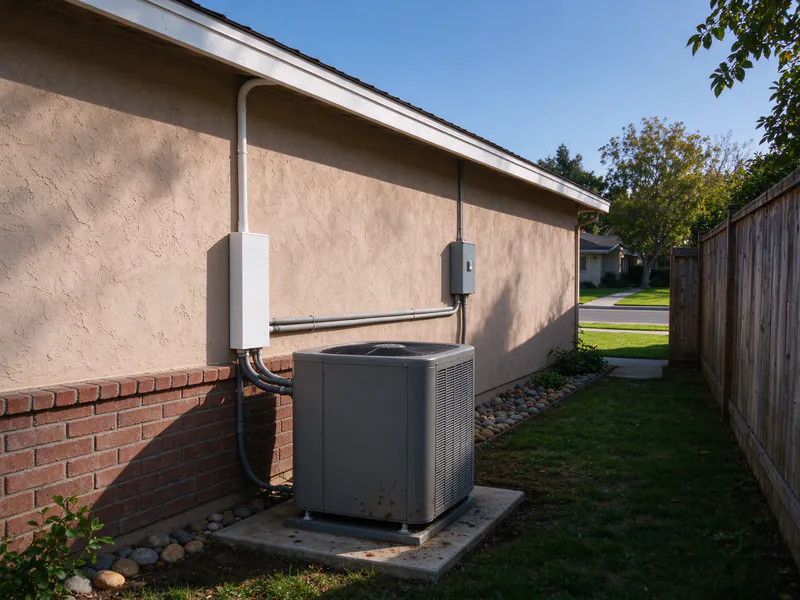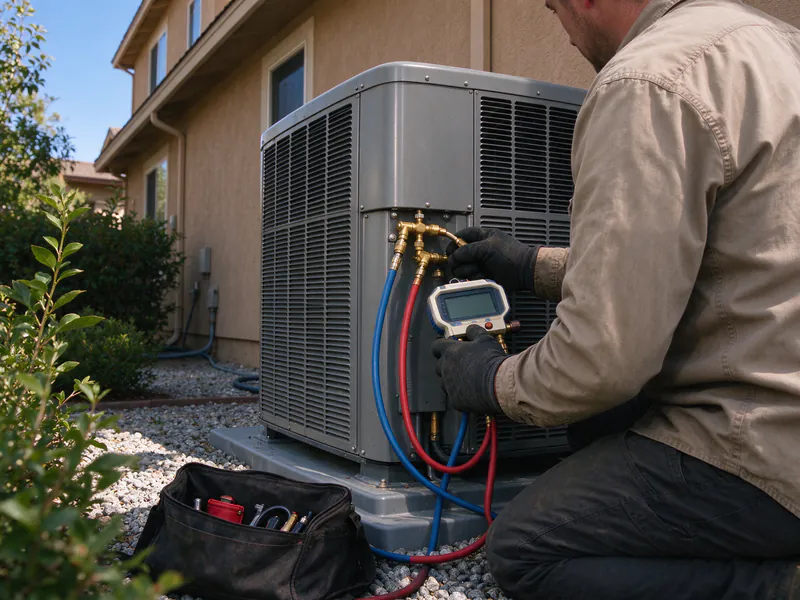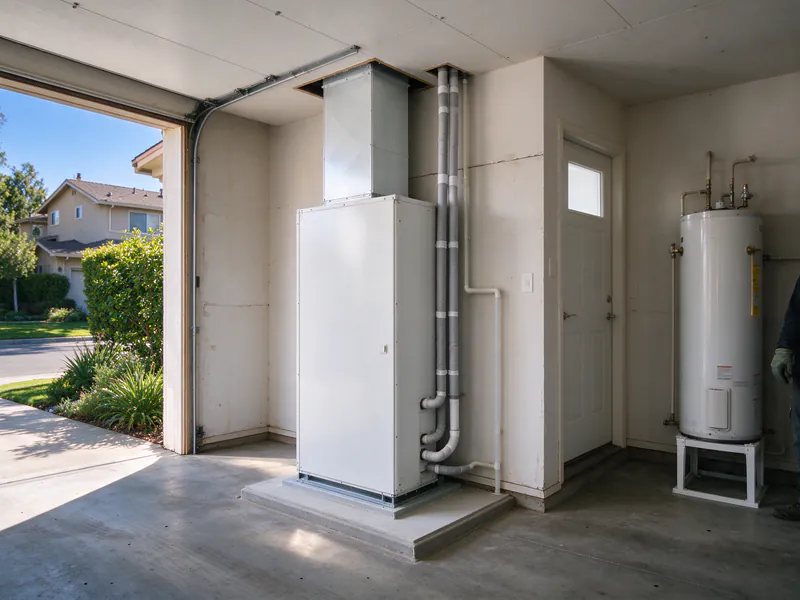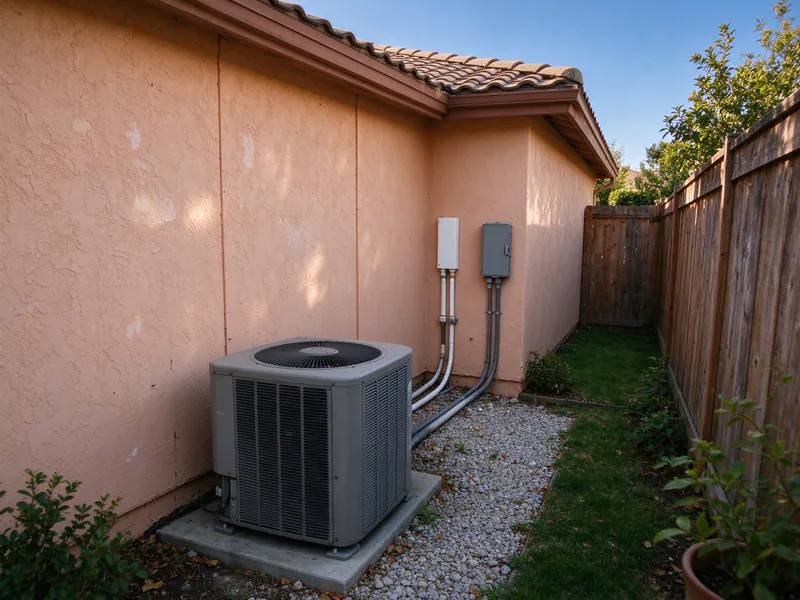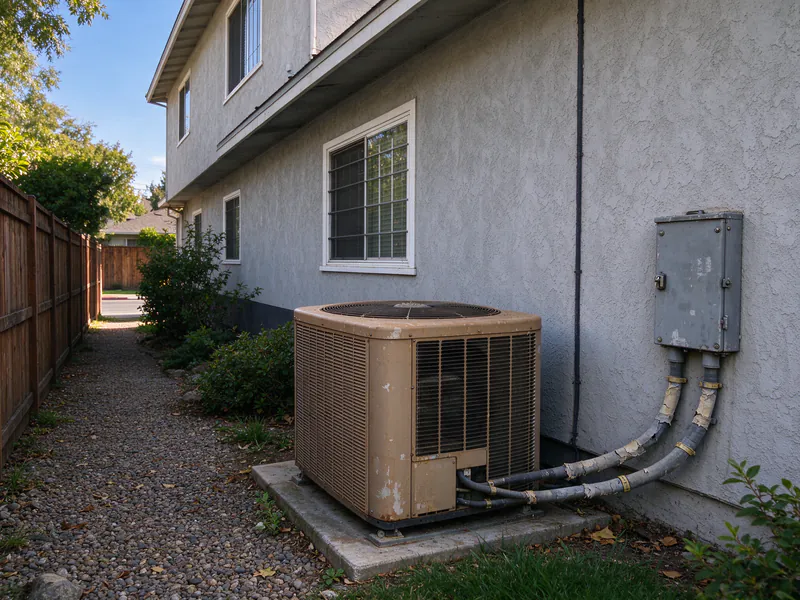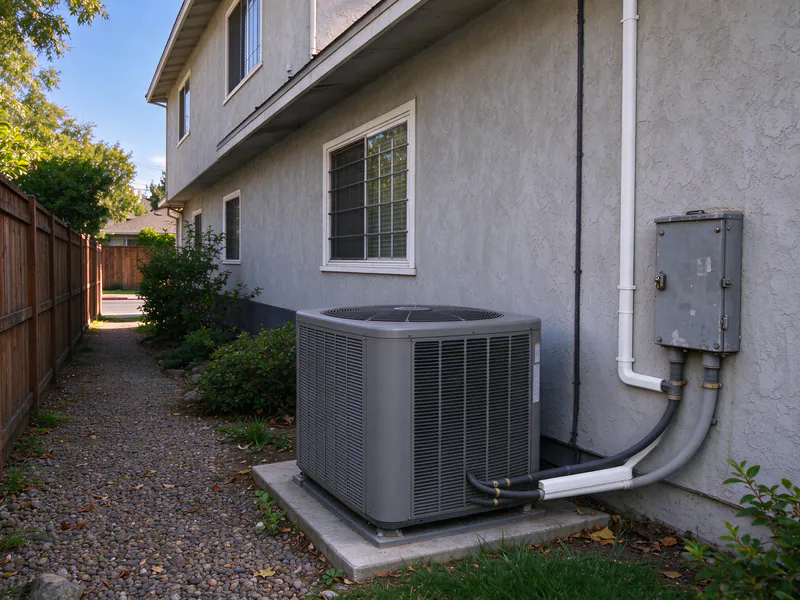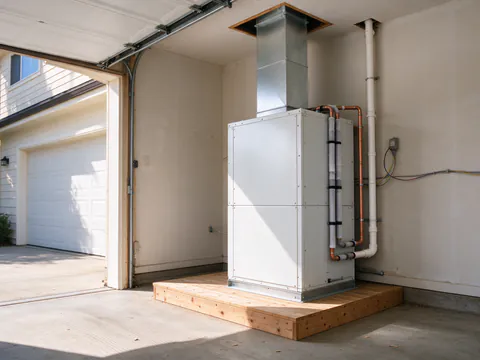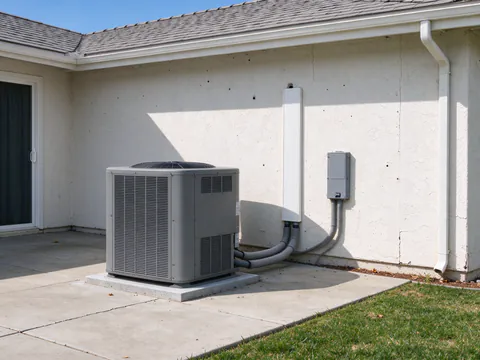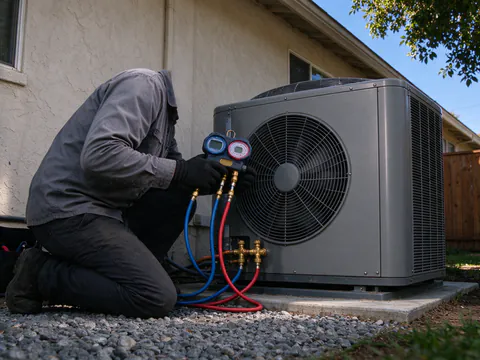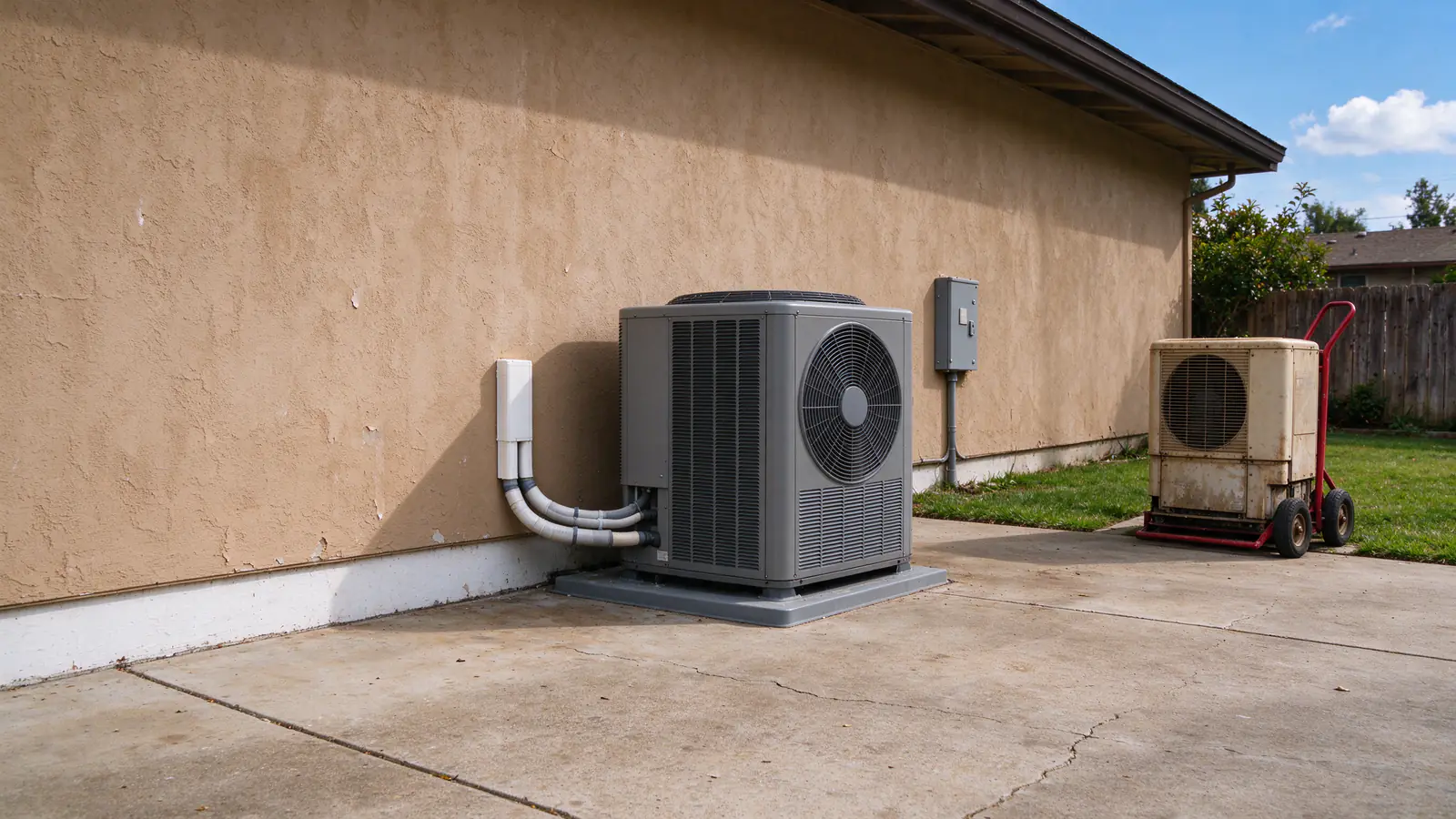
Tule Sacramento Heat Pump replaces worn-out heat pumps in homes across Sacramento County, south Placer County, east Yolo County and El Dorado Hills, with the installation carried out by licensed and insured contractors. A replacement is a heat pump going in where a heat pump already was, so the house already has the ducts, the 240-volt circuit and the outdoor pad. What it may not have is a system that was sized, matched and charged correctly the first time.
That is why a replacement starts with the house rather than the model plate. The old unit’s tonnage, refrigerant and air handler all come into question, and the answers decide whether the job is a simple swap or something larger.
Replace or repair: reading the signs
A heat pump is usually worth replacing when a major part fails on an older system, when repairs keep returning, or when the house was never comfortable with it. A single failed capacitor, contactor or fan motor on a younger unit is a repair. Heat pump repair covers that diagnosis; this page covers what happens when replacement is the better answer.
Age and repair history
No single age tells you a heat pump is finished. A compressor failure, a leaking outdoor coil or a second refrigerant leak on a unit well into its service life tends to push the decision toward replacement, because the repair cost lands on equipment with less time left. The heat pump lifespan guide explains what shortens or extends that service life.
Comfort that never worked
If a back bedroom has always run hot in August, or the system short-cycles in spring, a new unit of the same size on the same ducts will likely repeat it. The cause may be sizing, duct airflow or controls, and the visit below is built to tell those apart before anything is bought.
What happens on the first visit
The visit collects what the replacement scope depends on.
- The existing equipment. Outdoor unit and air handler ages, model numbers, refrigerant type, strip heat size, and where the air handler sits: attic, garage or hall closet.
- The load. A room-by-room Manual J calculation at local design conditions. For Sacramento’s airport station the California Energy Commission lists 98°F at the 1% cooling level and 31°F at the 0.2% heating level; Rocklin’s station runs hotter and colder, at 103°F and 26°F.
- The ducts. Static pressure, return size, visible damage and any record of an earlier ECC-Rater test.
- The line set. Diameter, length, route and the condition of its insulation.
- The electrical side. Breaker size, the disconnect and panel capacity against the new unit’s nameplate.
- The outdoor spot. Pad condition, clearances and where defrost water drains.
Everything lands in a written scope that names the equipment pair, the line set decision, any duct or electrical work and the permit.
Sizing the new system from the house
The old heat pump’s tonnage is a starting clue, not an answer. It may have been oversized at install, and new windows, attic insulation or a room addition change the load since. A properly sized replacement runs longer, steadier cycles, which evens out room temperatures and cuts the start-stop wear that shortens compressor life.
What the rules allow
Title 24 sets a ceiling for replacement heat pumps whose airflow isn’t verified at 350 cfm per ton: in a cooling-dominated climate like Sacramento, cooling capacity may exceed the calculated cooling load by no more than 6,000 Btu per hour, and heating capacity may exceed the heating load by no more than 12,000.
The City of Sacramento’s standard web permit adds its own condition. Of 1,950 heat pump permits the City issued from October 26, 2025 to October 25, 2026, 1,682 carried the line that the new unit “shall not exceed the size of the existing unit by more than 25%.”
Why the calculation gets skipped
Homeowners report contractors who sized by square footage or by counting registers, and Sacramento posters describe quotes where nobody ran the calculation at all. A load calculation takes measurements of every room, window and wall, which is the reason it gets skipped and the reason it matters. The heat pump sizing guide walks through how the loads are built.
Line set, air handler and the refrigerant change
Under the EPA’s Technology Transitions rule, new residential heat pump systems installed since January 1, 2025 must use a refrigerant with a global warming potential below 700, which in practice means R-454B or R-32. Systems built entirely from components manufactured or imported before that date have no installation deadline, so some older-refrigerant stock is still installed.
Why the indoor half usually changes too
A new outdoor unit is rated with a specific indoor coil or air handler. Pairing a new R-454B outdoor unit with a coil built for R-410A gives a system with no rated match, uncertain capacity and no path to the SMUD rebate.
When the air handler is replaced, its electric strip heat, filter rack, condensate pan and drain are replaced with it. Some systems using these newer refrigerants also carry leak detection requirements at the indoor unit. The R-454B refrigerant guide covers the transition, and air handler replacement covers the indoor half on its own.
Reuse or replace the line set
Reusing the copper lines saves opening walls or attics, and many lines can stay. They must match the diameter and length limits the new unit’s installation manual sets, carry no oil or contamination the new refrigerant can’t tolerate, and hold a nitrogen pressure test. Lines that fail any of those, or that run through an attic with crushed insulation, are replaced.
The Title 24 test on a like-for-like swap
What the ECC-Rater checks
California treats a heat pump change-out as an alteration even when nothing else changes. The California Energy Commission’s HVAC FAQ states that replacing the outdoor or indoor unit of a split system by itself triggers duct sealing, and that kept ducts must be tested by the installer and an ECC-Rater. The target is 10% total leakage or 7% leakage to the outside; ducts that can’t reach it have every accessible leak sealed and confirmed by a visual and smoke test.
The rater also verifies refrigerant charge, which heat pumps require in every climate zone, with at least 300 cfm of airflow per ton. The thermostat must be a digital setback model whenever a refrigerant component is replaced.
Who issues the permit
In the City of Sacramento, one- and two-family change-outs go through the online minor permit path, and the HVAC change-out carries a $175 flat fee plus surcharges. Unincorporated Sacramento County issues residential heating and cooling replacements through its Citizen Access Portal once payment is made, and Elk Grove has its own online HVAC replacement permit. The permit and Title 24 guide covers each office.
Outdoor placement and defrost drainage
Keeping the new unit where the old one sat keeps the City’s web permit simple, since its standard text requires the same location. Moving it is possible but changes the permit path and the line set. The placement and noise guide covers clearances and neighbors.
Valley winters bring frost, not snow. NOAA’s normals for Sacramento Executive Airport put the January 7 a.m. temperature at 41.6°F, with one morning in ten near 32°F, and humid fog-season air frosts the outdoor coil often. Each defrost cycle sheds water, so the pad or riser has to let it drain away instead of pooling and refreezing under the unit.
SMUD rebates for electric-to-electric upgrades
SMUD pays $1,000 when a qualifying two-stage or variable-stage heat pump replaces an existing electric system, such as an older heat pump or electric resistance heat. Single-stage systems are not eligible. The rebate requires qualifying equipment installed by a participating contractor in the SMUD Contractor Network, a Wi-Fi seven-day programmable thermostat, permits, a passing Title 24 verification and R-8 insulation on any new ducts.
Requesting a rebate-qualified installation
Rebate-qualified installations are available on request, and eligibility is confirmed per project under SMUD’s terms. Roseville Electric lists no residential heat pump HVAC rebate, and no PG&E single-family heat pump rebate was found. The SMUD rebate guide has the full eligibility list.
What a heat pump replacement costs
SMUD’s published median for electric-to-heat-pump upgrade projects is about $17,000 for split systems and about $19,000 for package units, before rebates. SMUD’s category mixes heat pump swaps with replacements of electric resistance heat, and individual projects range widely, so treat these as midpoints rather than a band.
What moves the number
Replacing the air handler along with the outdoor unit, a new line set through a finished wall, a variable-speed system, duct sealing that turns into duct replacement, or a panel with no room for the new breaker all push the price up. The heat pump replacement cost guide breaks it down, and the cost estimator gives a range without a phone call.
When a replacement becomes a bigger project
A replacement is also the moment to change the type of system. A variable-speed heat pump can slow down to match mild spring and fall loads instead of cycling on and off at full output. If the ducts fail the leakage test badly or can’t carry 300 cfm per ton, heat pump ductwork covers sealing, resizing and full replacement. If the existing unit is a single box on the roof or beside the house, package heat pump replacement explains how that swap differs.