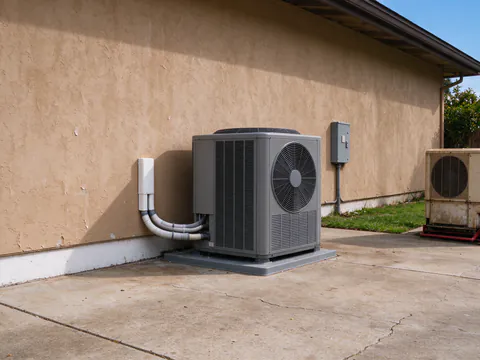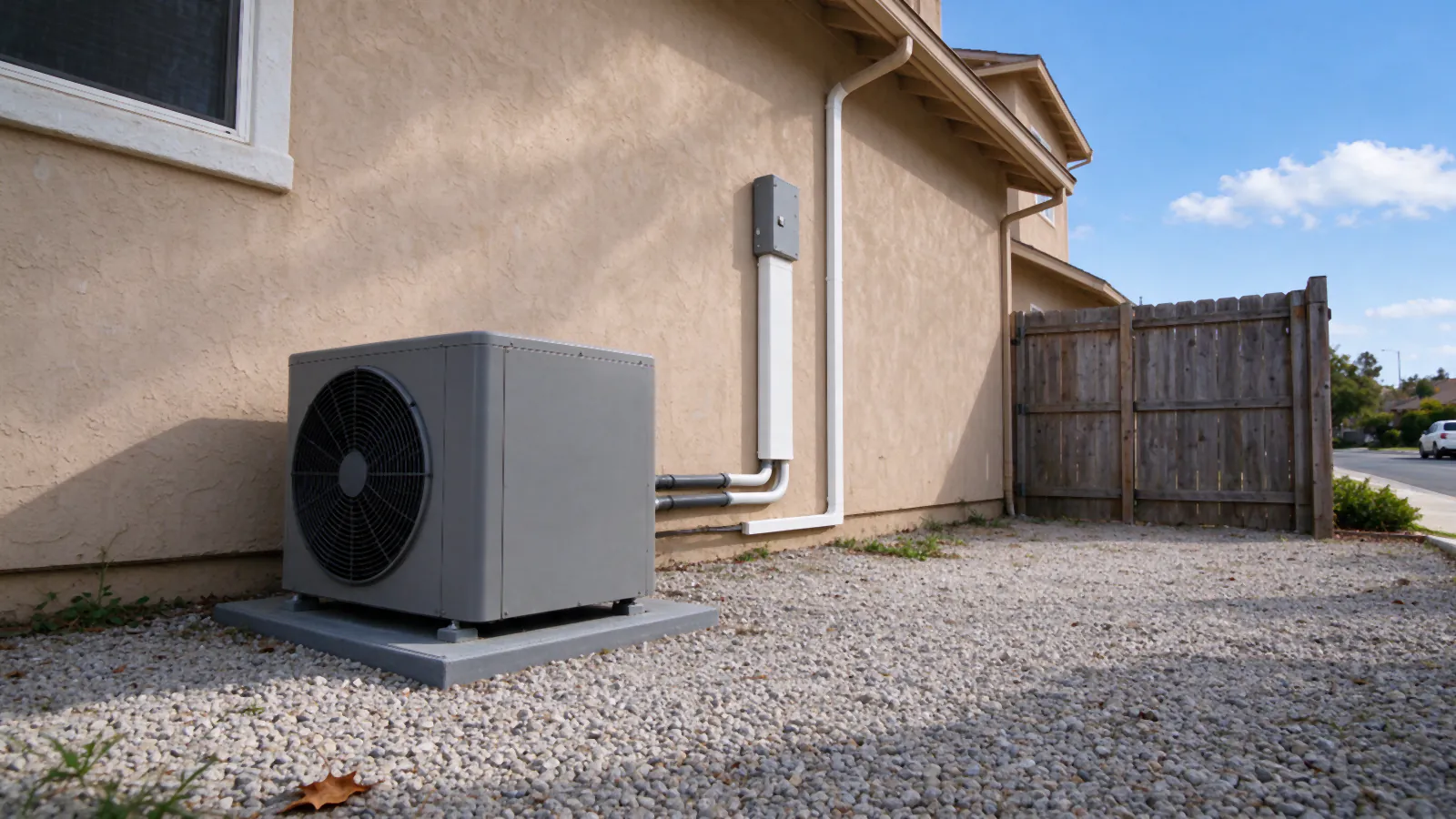
A heat pump’s outdoor unit belongs where it can pull in fresh air on every side, shed defrost water away from the house, be reached for service and sit far enough from bedrooms and neighbors that its sound does not intrude. In a change-out that is often the old condenser’s spot. Moving it is possible, but it changes the permit path and the line set, electrical and pad work.
Tule Sacramento Heat Pump plans and installs ducted heat pumps across the Sacramento region, with licensed and insured contractors setting the equipment. This guide covers what decides a good location and what makes a unit quieter.
What a good location needs
Airflow
The coil pulls air in through its sides and pushes it out the top or front. Each manufacturer publishes minimum clearances on every side and above. Fences, dense shrubs, a deck overhang or a second unit closer than that make the coil breathe its own exhaust. In summer that cuts cooling capacity; in winter it worsens frost.
Drainage
In heating mode the outdoor coil collects frost, and every defrost cycle melts it off. On damp winter mornings in the Sacramento Valley that can happen several times. The water has to drain away from the unit and the foundation. NOAA records no measurable snow at valley-floor stations, so the pad height is about drainage and keeping sprinkler spray and splash off the coil, not about snow.
Service access
A technician needs room to open panels, connect gauges and clean the coil. The electrical code requires a disconnect within sight of the unit.
Things to keep away from
- dryer vents, which coat the coil with lint
- sprinkler heads aimed at the unit
- roof drip lines and downspouts without gutters
- spots where leaves or cottonwood fluff collect
Moving the unit: what the permits say
City of Sacramento
City permit records show the standard web permit text for a change-out: the new unit is placed in the same location as the existing one and may not exceed its size by more than 25%. Of 1,950 heat pump permits issued from October 26, 2025 to October 25, 2026, 1,682 carried that condition. Relocating the unit takes the job off that simple path.
Roseville
Roseville’s residential mechanical checklist asks for complete, stamped and signed plans if a new mechanical unit goes in the attic or on top of an existing roof. A like-for-like ground unit swap does not need them.
State law
SB 222 defines a swapout for its streamlined permitting as a same-location replacement needing no more than 25 linear feet of new ductwork and not switching between package and split systems. Its online permitting deadline is July 1, 2028.
What else a move involves
A new location usually means a longer or new refrigerant line set within the manufacturer’s length limits, a new electrical run and disconnect, a new pad and sometimes a new condensate route. The permit and Title 24 guide covers the permit side.
Where sound comes from
Rather than quoting a decibel rating, it helps to know what makes the noise and how installation changes it.
| Source | What you hear | What reduces it |
|---|---|---|
| Compressor | A steady hum, loudest at full output | Variable-speed or two-stage compressors that run slowly most of the time; a compressor sound blanket where the model offers one |
| Outdoor fan | Rushing air | Lower fan speeds on variable-speed units; open clearances so the fan is not straining |
| Reversing valve | A short whoosh at the start or end of defrost | Nothing; it is normal |
| Vibration | A buzz carried into walls or floors | A level pad, isolation feet, a line set that does not touch framing |
| Reflection | Sound bouncing off walls and corners | Avoiding tight corners and narrow side yards between hard walls |
Mounting is half the result
A unit on an unlevel or sinking pad vibrates more. Refrigerant lines strapped tight to the house carry compressor vibration into the framing, which can be heard indoors even when the unit is quiet outside. Isolation pads, a properly supported line set and a level, stable base solve most of it.
Compressor speed
A variable-speed heat pump spends most of its hours below full output, which is quieter than a single-stage unit that runs full blast every time it starts. On the hottest Sacramento afternoons any system runs harder, as the hot weather guide explains.
Neighbors and bedrooms
A side yard between two houses can channel and reflect sound toward a neighbor’s window. Placement that keeps the fan discharge pointed away from bedrooms and patios helps. Some cities and counties have noise ordinances, so check yours if the unit will sit close to a property line.
Indoor noise is an installation issue too
Sound inside the house usually comes from airflow, not the outdoor unit. A heat pump moves more air than a furnace, so a return grille or ducts sized for an older system can whistle or roar. Enlarging the return or fixing restrictive runs quiets it and helps the system reach its capacity. Heat pump ductwork covers the fixes, and an attic or closet air handler’s location matters too, covered under air handler replacement.
Roof and package units
Some houses have a package unit on the roof or on a pad beside the house, with everything in one cabinet; 289 of the City of Sacramento heat pump permits in the same twelve-month window were roof-mount or package installations. Replacing it with a package heat pump keeps the same footprint; switching to a split system changes the layout. Roof work may need a crane and a curb adapter. The package heat pump page covers that path.
When a unit gets louder over time
A unit that was quiet and now rattles, grinds or bangs is telling you something: a loose panel, a failing fan motor bearing, debris in the fan, a settling pad or a compressor problem. Those belong under heat pump repair, and a clear, level location also helps the system last, as the lifespan guide explains.
Planning the location
For a replacement, start with the existing spot and check it against clearances and drainage; for a conversion, the old AC pad is usually the starting point. Heat pump replacement covers the rest of the scope. To have the site checked, call (916) 516-1454 or request an estimate.