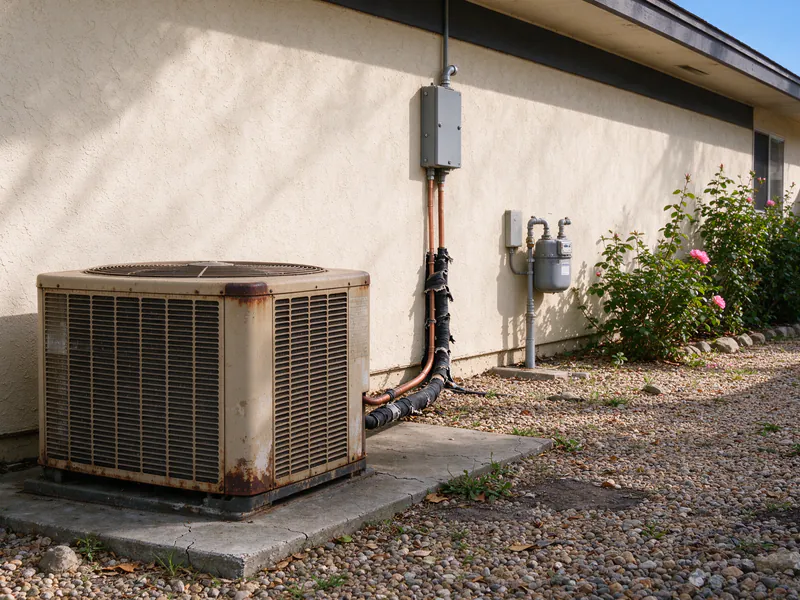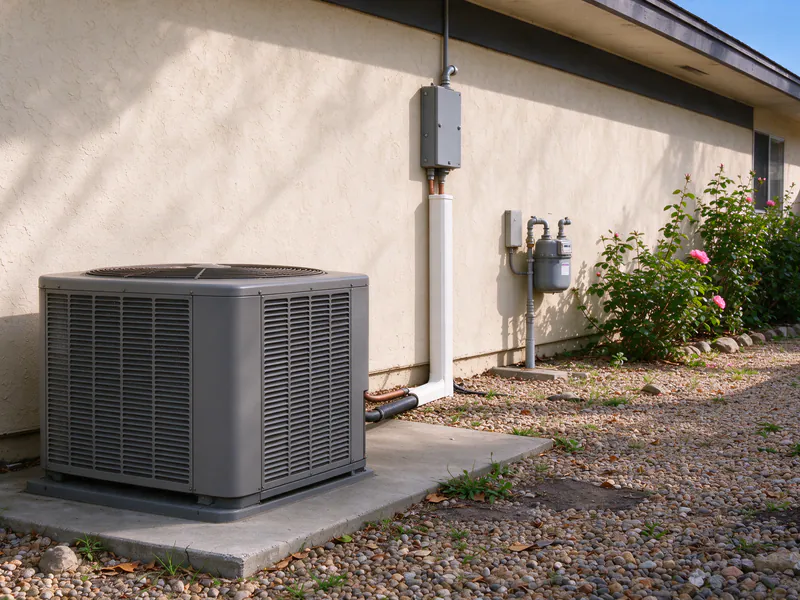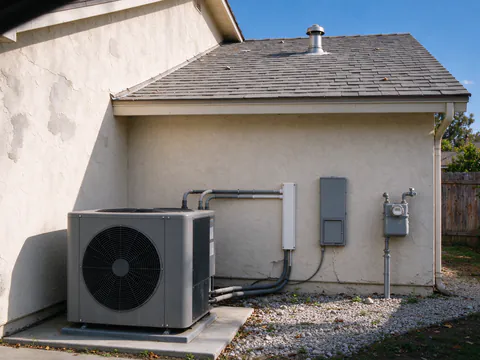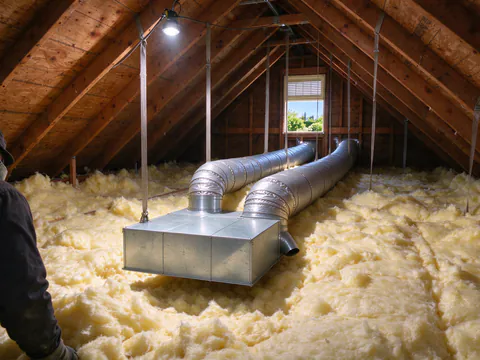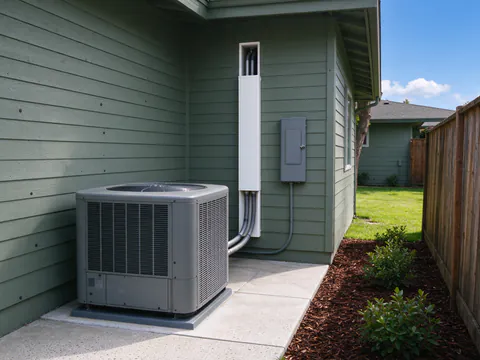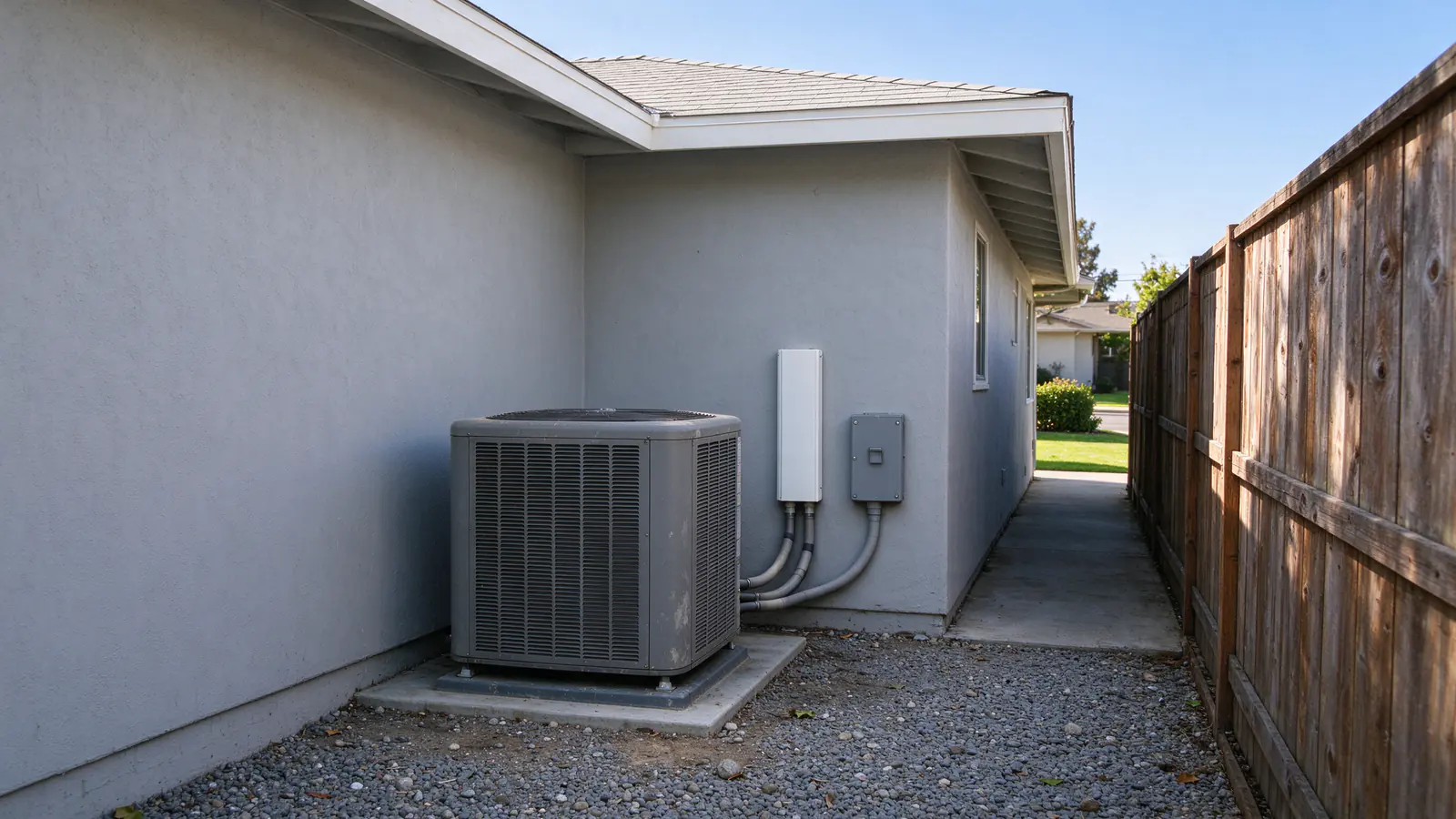
Tule Sacramento Heat Pump converts homes from a gas furnace and central air conditioner to one ducted, all-electric heat pump across Sacramento County, south Placer County, east Yolo County and El Dorado Hills. The work is carried out by licensed and insured contractors. One outdoor unit then does both jobs: it cools through the summer and reverses to heat in winter, using the ducts already in the house or new ones where the old ducts can’t deliver.
When a conversion makes sense
Most conversions start with age. A furnace and an air conditioner installed together tend to wear out together, and once one fails, the choice is between buying the same pair again or switching both to a single system. In Sacramento that choice turns on your electric utility more than on the equipment, which is why the first questions below are about the house, the ducts, the panel and the power bill.
What happens on the first visit
The visit gathers what the scope depends on, so the quote is written from measurements rather than the old equipment’s labels.
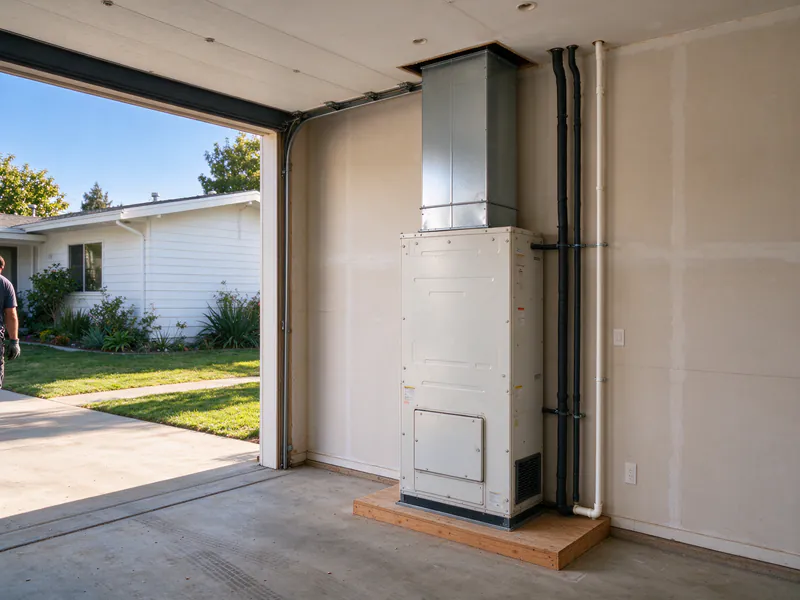
- The existing system. Furnace and AC ages and model plates, the coil on top of the furnace, the flue and the gas branch, and where the furnace sits: an attic, a garage or a hall closet changes how the new air handler goes in.
- The load. A room-by-room Manual J calculation at the local design conditions: 98°F at the 1% cooling level and 31°F at the 0.2% heating level for Sacramento’s airport station, per the California Energy Commission’s design data.
- The ducts. Returns, supply runs, visible damage and static pressure, and whether the system was ever tested by an ECC-Rater, because the result decides whether sealing or duct replacement belongs in the job.
- The panel. Service size, open breaker spaces and the existing AC circuit, since a heat pump with backup heat strips can need more than the AC it replaces.
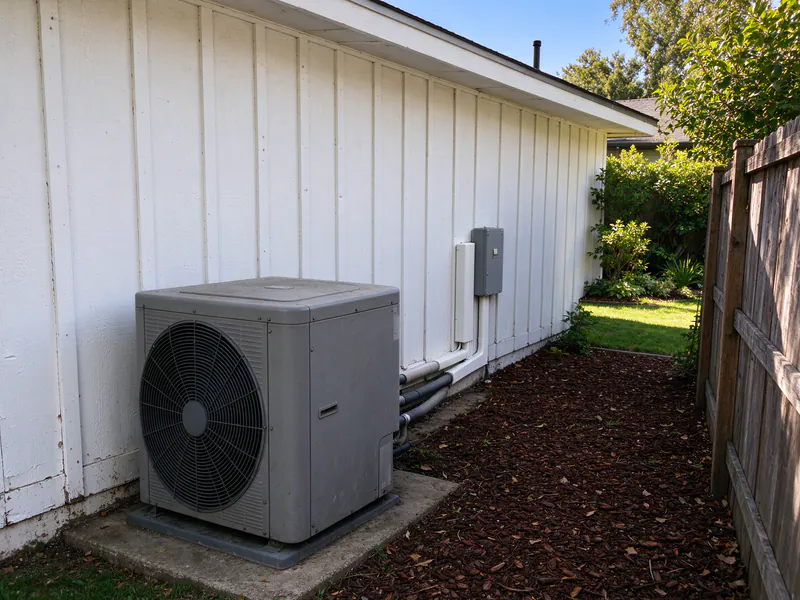
- The outdoor spot. Usually the old condenser location, which keeps the permit simple.
- Your utility. SMUD, Roseville Electric or PG&E, which changes both the rebate and the operating cost.
Everything goes into a written, itemized scope that names the equipment, the duct work, any electrical work and the permit.
Why your electric utility decides the economics
In SMUD territory, a heat pump heats for less than a 95% efficient gas furnace once it delivers about 1.4 units of heat per unit of electricity at off-peak winter rates, or about 2 at the 5 to 8 p.m. peak. On PG&E’s E-ELEC heat pump rate the bar is about 3.1 to 3.5. Those break-even figures are derived from the utilities’ published tariffs and PG&E’s residential gas rate, energy charges only.
| Electric rate (winter) | Price per kWh | Break-even COP vs a 95% furnace |
|---|---|---|
| SMUD Time-of-Day, off-peak | $0.1285 | 1.41 |
| SMUD Time-of-Day, 5 to 8 p.m. peak | $0.1776 | 1.95 |
| Roseville Electric, Tier 1 (with surcharges) | $0.1546 | 1.70 |
| Roseville Electric, Tier 2 (with surcharges) | $0.1989 | 2.18 |
| PG&E E-ELEC, off-peak | $0.28468 | 3.13 |
| PG&E E-ELEC, peak | $0.32063 | 3.52 |
COP is heat delivered divided by electricity used. Against an older 80% furnace the bar drops further, to about 1.19 at SMUD’s off-peak price and 2.63 on PG&E’s E-ELEC off-peak price. Gas is supplied by PG&E everywhere in the area, so the gas side of the comparison is the same for every address; the electric side is what changes.
In practice, almost any modern heat pump clears SMUD’s bar. In PG&E electric territory such as West Sacramento, Davis or Rocklin, it takes an efficient system running well to beat gas on winter fuel cost, and the case rests more on replacing the air conditioner and removing the furnace at the same time.
Seasonal rates and fixed charges
Rates change from season to season, and fixed monthly charges are left out because they apply either way. The heat pump vs gas furnace guide runs the comparison in more detail, and the electric bill guide covers what changes month to month.
Sizing for the afternoon, not the furnace label
Sacramento is a cooling climate that also needs heat. NOAA’s 1991-2020 normals for Sacramento Executive Airport show about 76 days a year at 90°F or hotter and 14 at 100°F or hotter, against about 15 nights at or below freezing and essentially none at 20°F or below. A heat pump sized properly for the summer load usually covers the winter load too.
Why the old labels mislead
The furnace’s Btu rating says how much heat it could make, not how much the house needs, and an AC that was oversized at install keeps being replaced at the same tonnage. The California Energy Commission’s design data runs from 98°F at the 1% level to 104°F at the hottest 0.1% for Sacramento, so the load calculation decides how much of that range the system is built for.
What oversizing costs you
An oversized heat pump reaches the setpoint fast in spring and fall, shuts off and starts again, which wastes energy and leaves rooms uneven. Title 24 limits how far a replacement heat pump can exceed the calculated cooling and heating loads unless its airflow is verified at 350 cfm per ton. The heat pump sizing guide explains how the loads are built.
Ducts, airflow and the Title 24 test
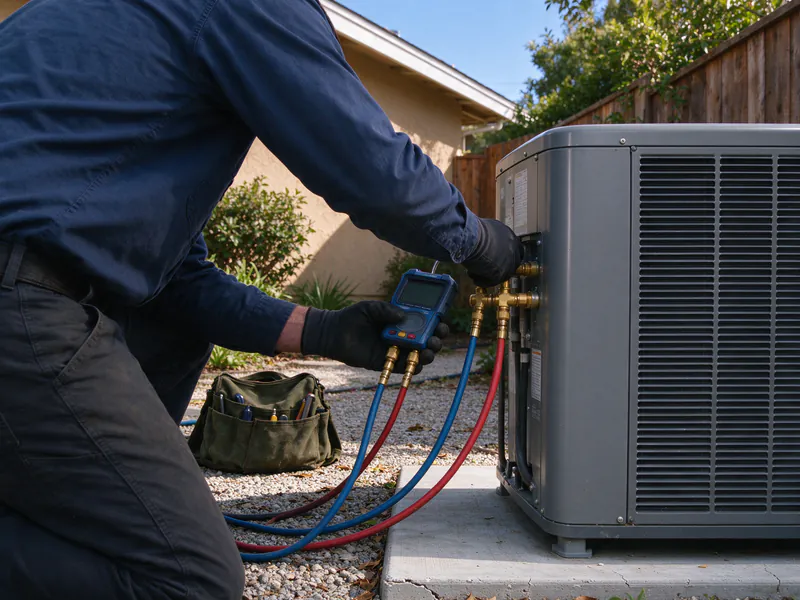
A gas furnace pushes air past 100°F, so a weak duct run still feels warm at the register. A heat pump delivers cooler supply air and needs more of it, at least 300 cfm per ton for the refrigerant charge verification under Title 24. Undersized returns, crushed flex runs and leaky joints that a furnace hid start to show up as rooms that never get comfortable.
What Title 24 asks of a change-out
California treats the change-out as an alteration. The California Energy Commission’s compliance manual requires the ducts connected to the new equipment to be sealed by the installer and verified by an ECC-Rater, with a target of 10% or less total leakage, or 7% or less leakage to the outside. If the ducts cannot reach the target, all accessible leaks are sealed and confirmed with a visual and smoke test. Exceptions include ducts that were already ECC-tested, systems with less than 40 feet of duct and ducts insulated with asbestos.
When the ducts get replaced
Most City of Sacramento heat pump change-outs reuse the ducts. Of 1,950 heat pump permits the City issued between October 26, 2025 and October 25, 2026, 1,167 were marked “No Duct Work Permitted” and 176 included new ducts. Where a house needs more than 25 feet of new duct, that duct must be insulated to R-8 and leakage tested, and an entirely new system must meet a 5% leakage limit plus airflow and fan rules. Heat pump ductwork covers testing, repair and replacement.
The panel, the circuit and the gas line
Electrical capacity
A heat pump often runs on a circuit similar to the AC it replaces. Backup electric heat strips are what add load, and an older 100-amp panel with no open spaces may need a load calculation or an upgrade first.
Panel work is a common companion to electrification: 719 City of Sacramento permit descriptions issued from January 1 to October 25, 2026 mention a main panel or service upgrade. A standard 100- to 200-amp upgrade typically runs about $1,500 to $4,500 in the Sacramento area. The electrical panel guide explains when it is needed.
Backup heat rules
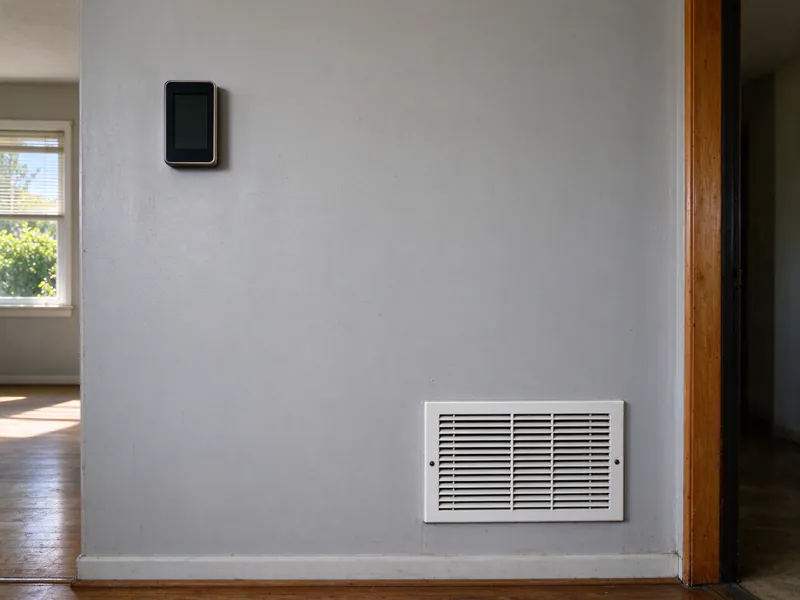
Title 24 does not allow electric resistance as the primary heat in a replacement space heating system unless an exception applies, which is one reason a conversion goes to a heat pump rather than an electric furnace. Backup strips are set to run only when the heat pump needs help, and the thermostat must be a digital setback model when refrigerant components are replaced.
The gas side
The furnace’s gas branch is capped and the flue opening closed. If you still have a gas water heater or range, the gas service stays.
SMUD rebates and what else is available
SMUD offers $3,000 for a qualifying variable-stage heat pump that replaces gas heating and $2,000 for a two-stage system of at least 15.2 SEER2. Single-stage systems are not eligible. The rebate requires qualifying equipment installed by a participating contractor in the SMUD Contractor Network, a Wi-Fi seven-day programmable connected thermostat, permits, new ducts insulated to at least R-8 and a passing Title 24 verification.
Rebate-qualified installations are available on request, and eligibility is confirmed per project under SMUD’s current terms. SMUD also offers additional rebates for panel and circuit work on gas-to-electric projects, subject to funding.
What has closed
Most other incentives have closed. TECH Clean California stopped taking reservations on November 14, 2025, the federal HEEHRA rebates in California are fully reserved, and the federal 25C tax credit ended for equipment placed in service after December 31, 2025. Roseville Electric lists no residential heat pump HVAC rebate, and no PG&E single-family heat pump rebate was found. The SMUD heat pump rebate guide and the California rebate guide track the details.
What a conversion typically costs
For a Sacramento-area home replacing a gas furnace and central AC with a ducted heat pump, about half of recent projects land between roughly $15,000 and $24,000 before rebates, with typical jobs near $18,000 to $19,000. When the ducts are replaced in the same project, the typical range is about $20,000 to $31,000. These are budgeting ranges, not a quote. The conversion cost guide breaks the number down, and the cost estimator gives a range for your house without a phone call.
When a full conversion is not the right call
A conversion suits an aging furnace, especially on SMUD power. If the furnace is only a few years old, a dual fuel heat pump keeps it as backup for the coldest mornings while the heat pump takes over cooling and most of the heating. If the air conditioner has failed and the furnace has years left, replacing the AC with a heat pump is the narrower first step.
For houses built before the 1950s, where ducts or panel capacity may be missing, heat pumps for older homes covers the extra work. Worried about a furnace ban? The California gas furnace rules guide separates what the state has adopted from what it hasn’t.