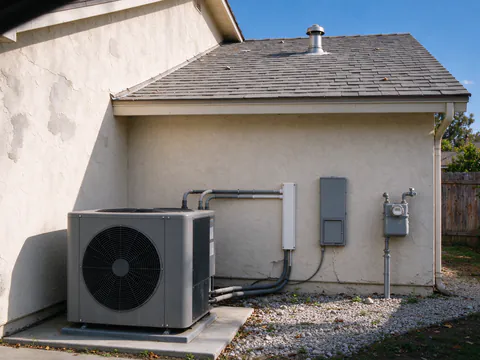
Aux heat is the backup a heat pump calls on when it cannot meet the load alone, usually electric resistance strips in the indoor air handler. On the Sacramento Valley floor it should run rarely: winter design temperatures sit around 30°F and nights at or below 20°F are almost unknown. Most aux heat here should come from defrost cycles on foggy mornings, not from cold.
Tule Sacramento Heat Pump installs ducted heat pumps across the Sacramento region, with licensed and insured contractors doing the work, and setting up backup heat controls is part of every commissioning. This guide explains what those settings decide.
What counts as backup heat
Electric strips
Resistance coils in the air handler, switched on in stages by the thermostat. They turn electricity into heat one for one. Simple and reliable, but the most expensive heat in the house.
A gas furnace
In a dual fuel system, the existing furnace stays as the backup. The controls switch from heat pump to furnace below a set outdoor temperature, and the two never run against each other.
No backup
Some valley-floor houses with a well-sized system and good envelope could run without strips for capacity. Title 24 also limits electric resistance as primary heat in a replacement system. Many designs still include a small strip stage for defrost comfort and for the occasional colder morning.
How cold the valley floor gets
NOAA’s 1991-2020 normals count about 15 nights a year at or below freezing at Sacramento Executive Airport and about 23 at Sacramento Metro Airport, with 0.0 and 0.2 nights at or below 20°F. Woodland averages about 9 freezing nights, Davis about 18.
The foothills differ. Placerville averages about 30 freezing nights and 0.4 at or below 20°F, and its 0.2% heating design is 26°F, as are Rocklin’s and Citrus Heights’. Capacity at low temperatures matters more there, as it does for homes in Rocklin and El Dorado Hills at the region’s edges.
| Station | Nights at or below 32°F | Nights at or below 20°F |
|---|---|---|
| Sacramento Executive Airport | 15.4 | 0.0 |
| Sacramento Metro Airport | 22.8 | 0.2 |
| Davis 2 WSW | 17.7 | n/a |
| Auburn | 19.6 | 0.2 |
| Placerville | 30.0 | 0.4 |
Why cold-climate equipment is not required here
Cold-climate heat pumps are built to hold capacity far below freezing. The valley floor rarely asks for that. Equipment sized for Sacramento’s summer afternoon usually has enough heating capacity at a 31°F design morning, which the sizing guide explains. Foothill homes are the exception worth a closer look.
Tule fog and defrost
The real winter test is damp air near freezing. NOAA’s hourly normals at Sacramento Executive Airport put the January 7 a.m. normal at 41.6°F, with one morning in ten at 32.3°F or colder, and the mean January dew point at 41.3°F.
Why frost forms
To pull heat from outdoor air, the outdoor coil runs colder than the air around it. On a damp morning that coil drops below the dew point and below freezing, so moisture freezes onto the fins. Frost blocks airflow and cuts capacity.
What a defrost cycle does
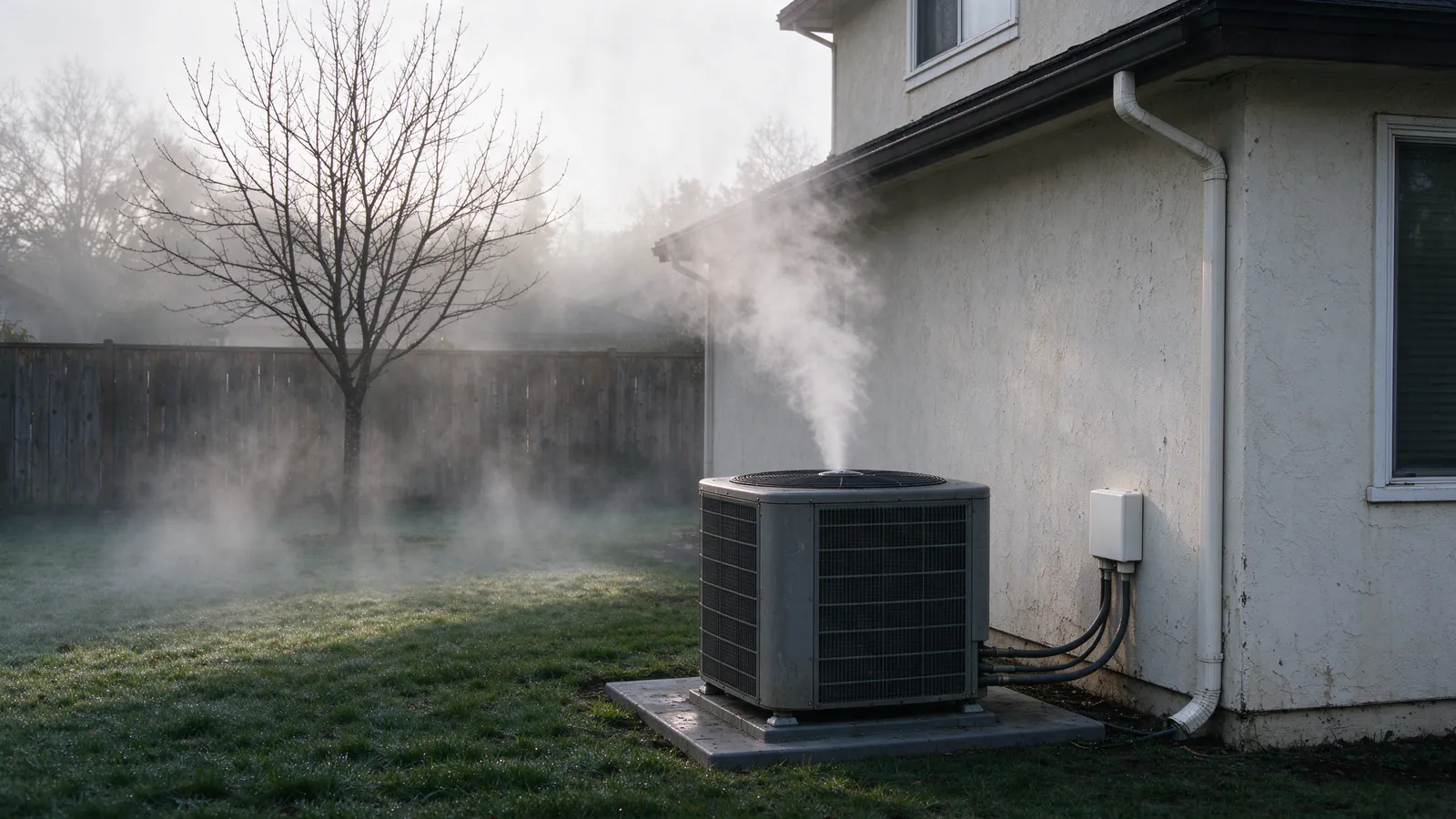
The control senses frost, through coil temperature, run time or both depending on the design, and reverses the system into cooling mode for a few minutes. Hot refrigerant runs through the outdoor coil, the frost melts, and the outdoor fan usually stops so the coil warms faster. You may see steam and water running off the unit. Then it switches back.
What you feel indoors
During defrost the indoor coil is briefly cooling. Without backup, air at the registers turns cool for a few minutes. That is the main job for a small strip stage in this climate, and it is why aux heat often lights up on fog-season mornings.
Normal frost versus a problem
Light frost that clears every cycle is normal. A coil that stays iced, ice building on the base or top, or a unit encased in ice points to blocked airflow, a defrost control fault or low refrigerant. Those need heat pump repair, not a thermostat change.
What backup heat costs to run
Electric strips have a COP of 1. Working from published tariffs and PG&E’s residential gas baseline, the break-even COP against a 95% gas furnace is about 1.41 on SMUD’s winter off-peak rate and about 3.13 on PG&E’s E-ELEC off-peak rate. Strips fall below both, so every hour on strips costs more per unit of heat than the furnace would have.
The heat pump itself clears the SMUD bar easily. That is why the controls matter: a system that uses its strips freely can lose much of the savings that justified it. The electric bill guide runs seasonal costs by utility.
Controls that keep strips in check
Outdoor temperature lockout
An outdoor sensor tells the system not to run strips above a set temperature, except during defrost. The setting belongs at or below the balance point from the load calculation.
Setback recovery
A deep night setback followed by a jump in the morning can make the thermostat call for strips to catch up quickly. Smaller setbacks, or a thermostat with heat pump recovery logic, let the compressor do the work over a longer ramp.
Staging
Multi-stage strips should come on one stage at a time, with the heat pump running first.
Thermostat compatibility
A heat pump thermostat controls the reversing valve and backup stages separately; a communicating system may need the matching control from the equipment maker. Title 24 requires a digital setback thermostat when refrigerant components are replaced, and SMUD’s rebate requires a Wi-Fi seven-day programmable connected thermostat; the SMUD rebate guide lists its other conditions.
Supply air and comfort expectations
A heat pump’s supply air is milder than a gas furnace’s and runs for longer cycles. Held up to a register, that air can feel cool next to a furnace’s blast, even while the room holds its setting. Strips raise supply temperature but at high cost, so they should not be used to make air feel warmer.
Power outages
Every option here needs electricity. A heat pump and its strips stop in an outage, and so does a gas furnace, whose blower, igniter and controls are electric. Backup heat strategy is about cold and cost, not outages.
Choosing the backup
On SMUD power a heat pump with a small strip stage suits most valley homes. Where electricity costs more, as on PG&E rates, or where a furnace is young enough to keep, dual fuel can make sense, and strip size affects the panel question. To plan backup heat around your house and rate, call (916) 516-1454 or request an estimate.