
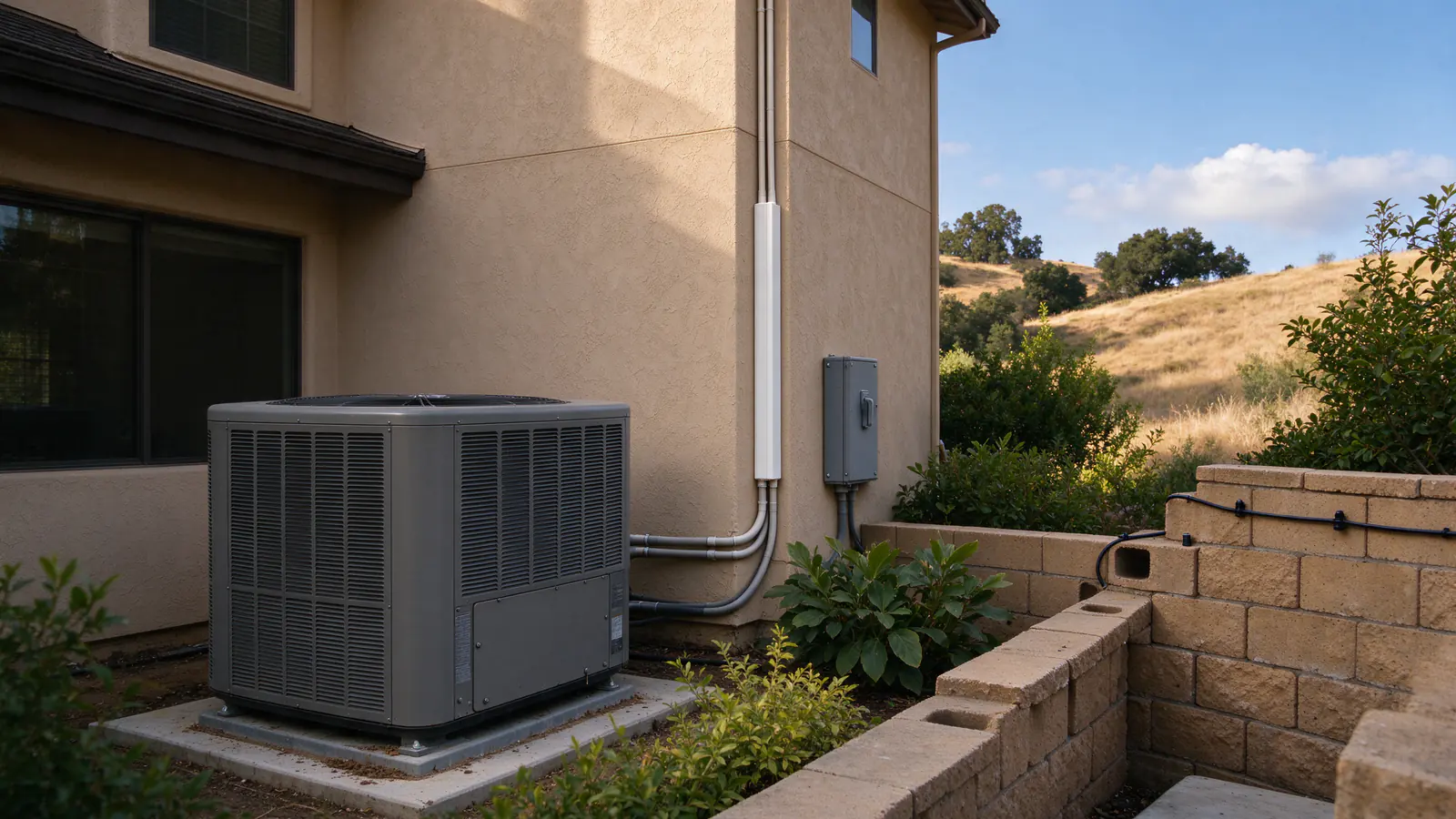
El Dorado Hills sits across a county line from Folsom, and that line moves three things a heat pump depends on: the electric utility, the permit office and the paperwork the installing contractor needs. Tule Sacramento Heat Pump plans ducted heat pump conversions and replacements in El Dorado Hills, with the installation carried out by licensed and insured contractors who meet El Dorado County’s requirements.
What changes at the county line
The climate barely shifts between the two communities. The administrative side changes almost completely.
| Folsom | El Dorado Hills | |
|---|---|---|
| Electric delivery | SMUD | PG&E |
| Generation | SMUD | Pioneer Community Energy |
| Permit office | City of Folsom | El Dorado County Building Services |
| Title 24 climate zone | 12 | 12 |
| Cooling design, 1% | 99°F (Folsom Dam) | 98°F |
| Heating design, 0.2% | 31°F (Folsom Dam) | 30°F |
| Utility heat pump rebate | SMUD, on qualifying equipment | None found |
The design figures come from the Energy Commission’s JA2 tables, and the utility split from its load-serving-entity maps. Near the boundary, the meter decides the utility, so it is read from a recent bill. The Folsom page covers the SMUD side.
Design weather at 673 feet
The Energy Commission’s station for El Dorado Hills sits at 673 feet, above the valley floor. Its cooling design runs 103°F at 0.1%, 100°F at 0.5% and 98°F at 1%. Its heating design is 30°F at 0.2% and 34°F at 0.6%, with a median annual extreme of 24°F.
What that means for the equipment
The summer numbers match Sacramento’s closely, so the cooling load usually sets the size here too. The winter numbers run a little colder than the valley, which makes the backup heat setting and defrost controls worth checking at commissioning rather than leaving at factory defaults. A properly sized ducted heat pump does not need cold-climate-rated equipment for these temperatures, but the aux heat and defrost guide explains when the backup strips should engage.
El Dorado County’s email permit program
What the handout covers
The County’s “Licensed Contractors Trade Email Permit Program” handout lists residential replacement of existing mechanical equipment, including electric and gas HVAC, ducts, furnaces, AC coils and condensers, as work that can be permitted by email without plan review. A heat pump that replaces a furnace and air conditioner in the same locations fits that description.
Who can use it
Participation requires an appropriate California contractor’s license, a current El Dorado County business license and a registered account on the County’s eTRAKiT system. Building Services can be reached at 530-621-5315. The handout dates from a 2020 revision, so the program’s status and fees are confirmed per project before the permit is filed.
What still follows the install
The email permit does not skip the state steps. Title 24 requires the ducts on a changed-out system to be sealed and tested, and the heat pump’s refrigerant charge and airflow verified, by an ECC-Rater. The permit and Title 24 guide explains the inspection sequence.
Houses from the 2000s and after
Census figures put 57.1% of El Dorado Hills homes as built in 2000 or later and only 11.9% before 1980, with 90.0% single-family detached and 87.5% owner-occupied. Those are community figures, not a finding about any one house.
The original system at replacement age
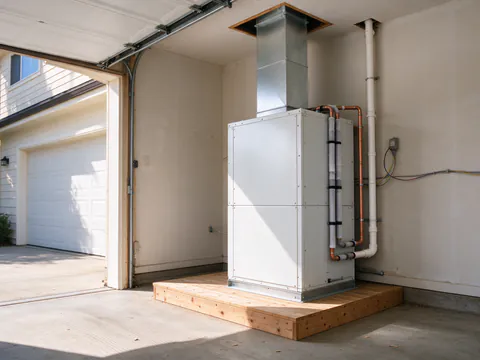
Where a house still has its first furnace and AC, a conversion usually swaps the outdoor unit and replaces the furnace with an air handler in the same location. The ducts are generally younger than in older suburbs, but they still have to pass the leakage test, and a 2000s return may be undersized for the 300 cfm per ton a heat pump needs to pass charge verification.
Hills, slopes and larger homes
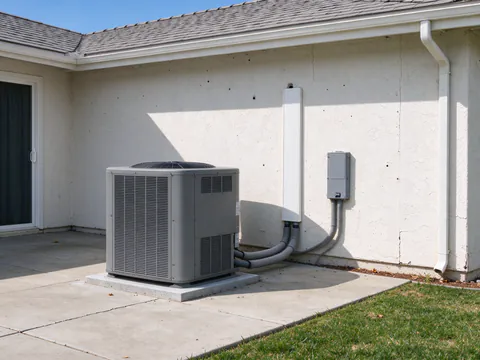
On a sloped or terraced lot, the outdoor unit location is chosen for a level pad, drainage of defrost melt water and line-set length. A larger two-story house may already have two systems, and each is sized and permitted on its own.
Gas, propane or electric: where the house starts
Most El Dorado Hills homes are on PG&E gas, but not all. The Census shows 6.9% of households here heat with tank or LP gas, and 27.4% across El Dorado County as a whole.
- PG&E gas furnace and central AC. A gas furnace to heat pump conversion removes the furnace and replaces the AC with one system.
- Propane furnace. The heat pump replaces propane for heating. The fuel comparison comes from your own delivery invoices, since no official local propane price series exists.
- Furnace with years left. A dual fuel heat pump keeps the furnace as backup for the coldest hours.
- Older electric heat pump. A like-for-like heat pump replacement with updated equipment.
Running costs on PG&E with Pioneer generation
PG&E’s E-ELEC plan, open to homes that use an electric heat pump as their primary heating and cooling, charges $0.28468 per kWh off-peak and $0.32063 at peak in winter, as bundled rates. Against PG&E’s residential gas baseline of about $2.54 per therm, the break-even for a heat pump against a 95% furnace is a COP of about 3.1 to 3.5. That figure is derived from the two tariffs. Pioneer’s generation rates replace PG&E’s generation portion, so the totals on your own bill are the real test.
Where the value comes from
Heating savings over gas are modest on PG&E rates. The case rests on replacing an aging AC and furnace with one system, on summer cooling efficiency, and on PG&E’s 4 to 9 p.m. summer peak, where a variable-speed heat pump running slowly costs less than a single-stage unit cycling hard. The heat pump vs gas furnace guide and the electric bill guide carry the comparison further.
Incentives
Neither SMUD’s heat pump rebate nor any PG&E single-family heat pump rebate applies here, and the statewide programs are closed. The California rebate guide lists what remains.
From first call to final inspection
- Bill and fuel check. The PG&E rate plan, Pioneer generation, and whether the furnace burns gas or propane.
- Assessment. Load calculation at the 98°F design, duct inspection, static pressure and the panel’s capacity.
- Scope and permit. A written, itemized scope, then the County email permit or standard permit.
- Installation. Old refrigerant recovered, equipment set, lines brazed, pressure-tested and evacuated.
- Verification. Airflow and charge, the ECC-Rater visit and the County’s final inspection.
For what pushes a quote above or below the typical range, see the Sacramento cost guide.