
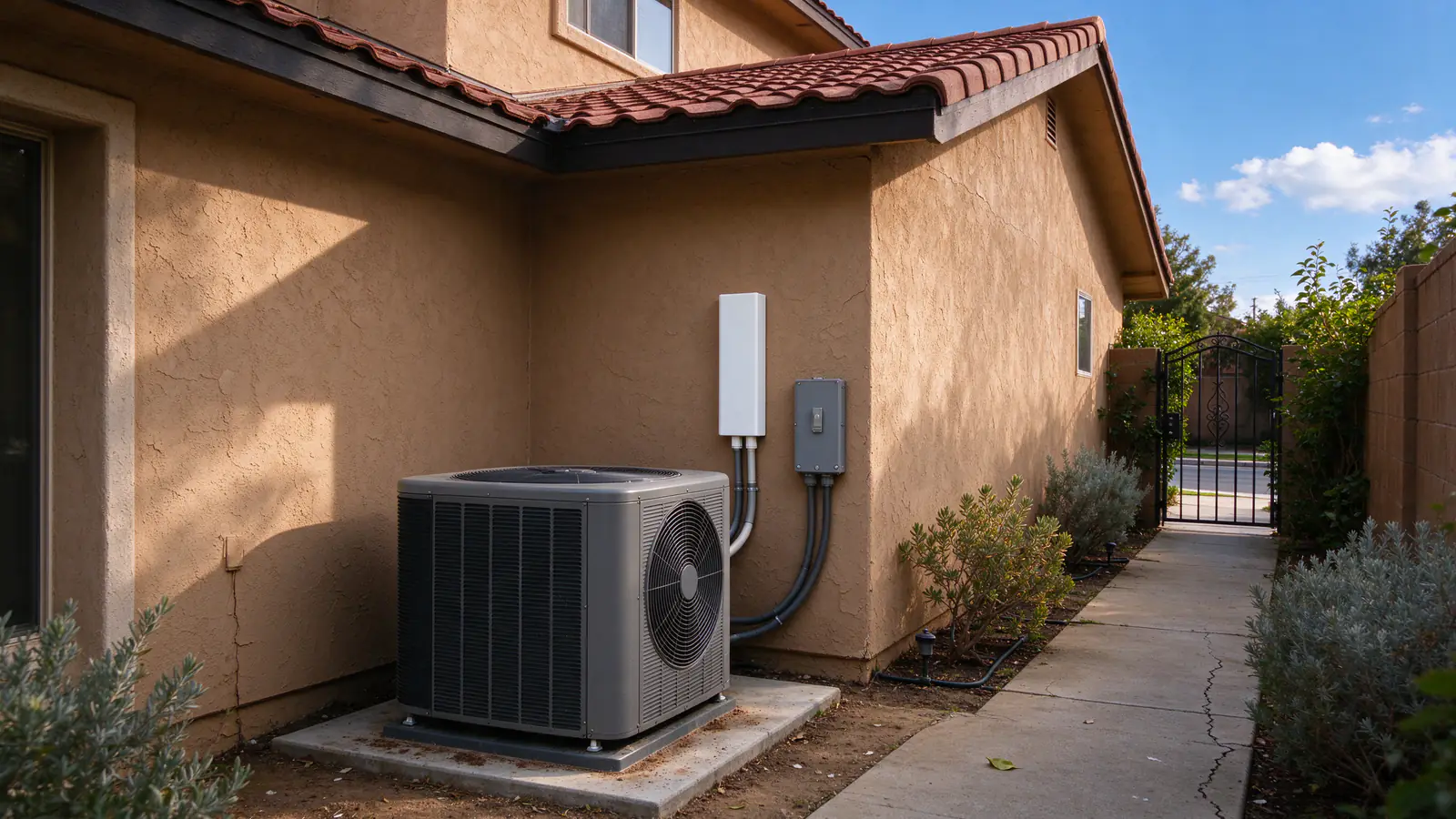
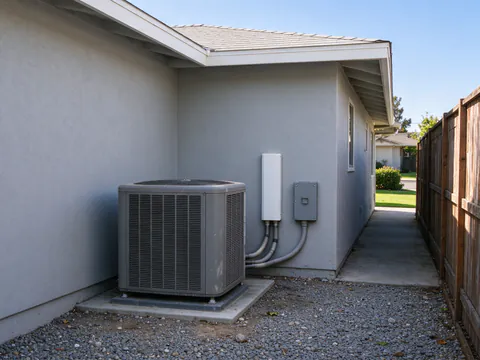
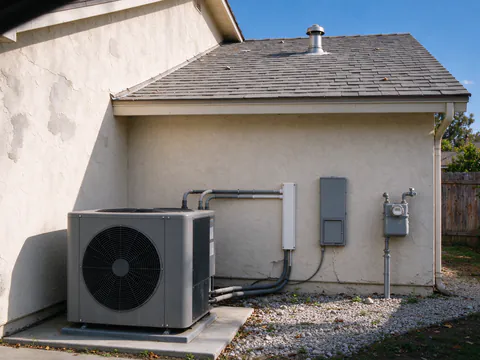
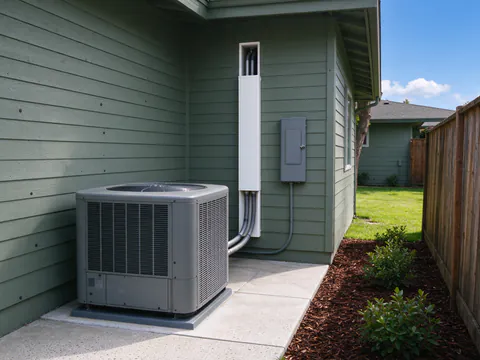
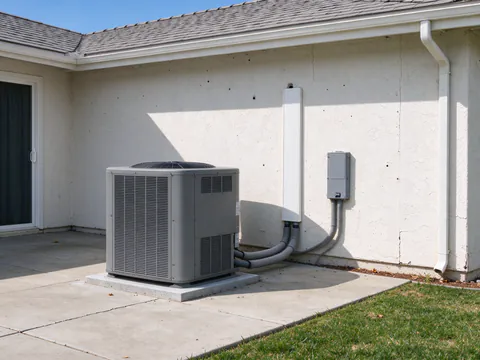
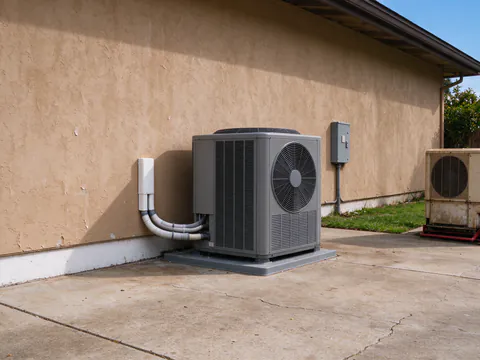
Folsom sits near the eastern edge of SMUD’s service territory. Cross into El Dorado Hills and the electricity comes from PG&E, with Pioneer Community Energy supplying generation, and the efficiency a heat pump needs to beat gas on winter fuel cost more than doubles. Tule Sacramento Heat Pump installs and converts ducted heat pumps across Folsom, from Historic Folsom and Natoma Station to Empire Ranch, Broadstone and the Folsom Ranch area, through licensed and insured contractors.
Where SMUD ends at the county line
The California Energy Commission’s utility maps place Folsom in SMUD territory and El Dorado Hills in PG&E’s, with Pioneer as the community choice provider. SMUD describes its territory as most of Sacramento County plus small adjoining parts of Placer and Yolo, so an address near the line is confirmed on the bill.
| Address | Electric provider | Break-even heat pump COP vs a 95% gas furnace |
|---|---|---|
| Folsom | SMUD | About 1.41 off-peak to 1.95 at peak |
| El Dorado Hills | PG&E delivery, Pioneer generation | About 3.13 to 3.52 on E-ELEC |
These are derived from each utility’s winter energy charges and PG&E’s baseline gas rate, leaving fixed charges out. On the Folsom side, almost any modern heat pump heats for less than gas. The heat pump vs gas furnace guide works through the comparison.
What every Folsom permit includes, and what is confirmed per project
Settled by state rules
Some parts of the permit don’t depend on which city issues it. The CEC’s HVAC FAQ states that installing a space-conditioning appliance requires a building permit. Title 24 then requires, on a heat pump change-out:
- Duct sealing and an ECC-Rater test, to 10% or less total leakage or 7% or less to outside, or every accessible leak sealed.
- Refrigerant charge verification, required for heat pumps in all climate zones, with a minimum 300 cfm of airflow per ton.
- A digital setback thermostat when a refrigerant component is replaced.
Confirmed with the City
The City of Folsom issues the building permit. Its application steps, any plan requirements for equipment moved to a new location and its fee are confirmed per address and project before the work is scheduled. That check happens during scoping, not after the quote.
Changes coming under SB 222
California’s SB 222 (Chapter 738, Statutes of 2026) requires cities to offer asynchronous inspections from July 1, 2027 and automated online permitting for licensed contractors by July 1, 2028. It caps the permit fee for a residential heat pump HVAC system at $200 unless the city adopts written findings. The permit and Title 24 guide tracks how offices are adapting.
Newer houses on gas heat
The Census Bureau’s American Community Survey counts 41.7% of Folsom’s homes as built in 2000 or later and 12.6% before 1980, and 70.4% of households heat with gas. For most Folsom households, then, the starting point is gas heat beside a central air conditioner.
Replacing furnace and AC together
A gas furnace to heat pump conversion removes both, sets one outdoor unit with a matched air handler, caps the gas line at the old furnace and seals the flue opening. Newer ducts are not exempt: they get the same Title 24 test, and its result decides how much sealing follows.
Keeping a furnace with years left
If the AC fails while the furnace is young, a heat pump can replace the AC and run beside the furnace as a dual fuel system. The furnace then becomes the cold-weather backup. On SMUD rates it would rarely run, which is why the two options are priced side by side.
Older houses in the mix
Where a Folsom house predates 1980, the checks shift toward the ducts and the electrical service. Original ducts may leak more or carry less air than a heat pump needs, and an older panel may lack room for a 240-volt outdoor circuit plus backup heat. Both are measured at the visit, and the heat pumps for older homes page covers what changes.
Design data from Folsom Dam
The CEC’s nearest design station, Folsom Dam, lists 99°F for cooling at the 1% level, 101°F at 0.5% and 104°F at 0.1%. Its heating design is 31°F at 0.2% and 35°F at 0.6%. Folsom is in Title 24 climate zone 12, the same as Sacramento.
What the numbers mean for sizing
The cooling design is a degree above Sacramento Airport’s, and on the valley floor the cooling load usually sets the size. A two-story house with a large west-facing wall can need more cooling upstairs than the totals suggest, which room-by-room loads catch. A variable-speed heat pump holds steady on long hot afternoons, and the hot weather guide explains what happens to capacity above 100°F.
Winter mornings and defrost
NOAA’s hourly normals for Sacramento put a typical January 7 a.m. at 41.6°F, with one morning in ten at 32.3°F or colder, and dew points close behind. That is defrost weather rather than a capacity problem: the outdoor coil frosts and clears many times on a foggy morning. The unit is set on a pad or stand where the melt water drains away from walks and the foundation.
SMUD rebates on a Folsom address
SMUD’s heat pump rebate reaches $3,000 for a variable-stage gas-to-electric replacement and $2,000 for two-stage equipment. A replacement of existing electric heat earns $1,000. Each requires qualifying equipment installed by a participating contractor in the SMUD Contractor Network, permits and a passing Title 24 verification. SMUD also offers additional rebates for panel and circuit work on gas-to-electric projects.
Rebate-qualified installations are available on request. The SMUD rebate guide has the conditions, and the Sacramento cost guide shows how they offset the price.
Putting a Folsom project together
- Intake. Equipment ages, where the furnace sits, the utility on the bill and the address.
- Home visit. Room loads, duct leakage and static pressure, the panel, and the outdoor unit’s position.
- Permit check. The City’s requirements for this scope confirmed, then the permit filed.
- Install. Old equipment out, refrigerant recovered, new system set, brazed, evacuated and charged.
- Final. Airflow and charge checked, the ECC-Rater visit, the City inspection and thermostat setup.