
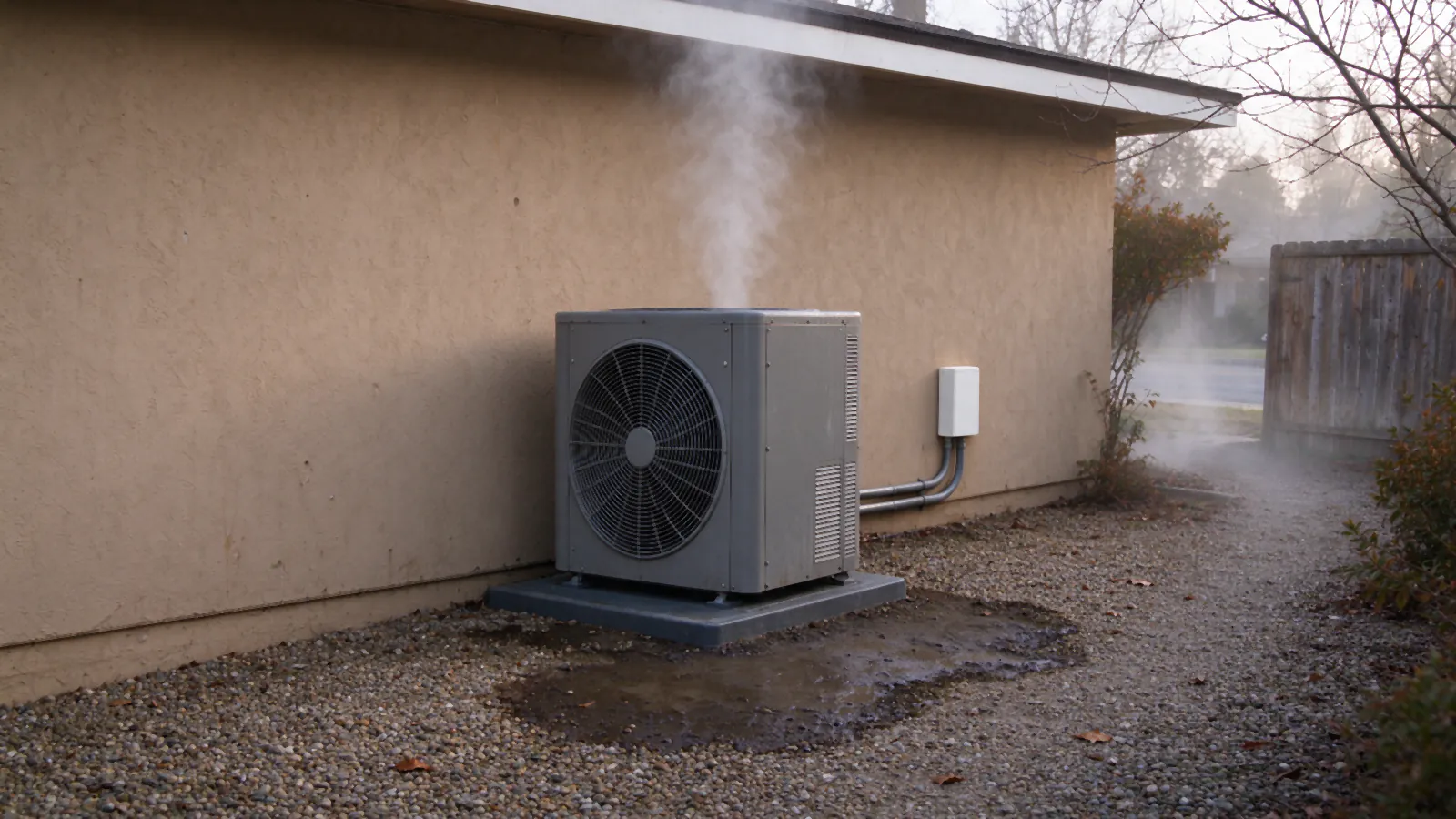
On a still winter morning in the Sacramento Valley, the outdoor unit of a heat pump can look like it is smoking. A plume of white vapor rises off the coil, the fan has stopped, and water is dripping onto the pad. Then, a few minutes later, the fan starts again and the unit goes back to quietly heating the house. That is the defrost cycle, and on a tule fog morning it is doing exactly what it was designed to do.
Where the tule fog name comes from
Tule Sacramento Heat Pump installs, replaces and services ducted heat pumps across the Sacramento region, and the business takes its name from this weather. Tule fog is the valley’s winter ground fog, named for the tule reeds of the marshes that once covered much of the valley floor. It is the condition a heat pump here heats through most often.
Why fog season frosts the outdoor coil
Cold, but not very cold
Sacramento winters are mild by heat pump standards. NOAA’s 1991-2020 hourly normals for Sacramento Executive Airport put the typical January 7 a.m. temperature at 41.6°F, with one morning in ten at or below about 32°F. The same station averages about 15 nights a year at or below freezing and essentially none at 20°F or below. The California Energy Commission’s heating design temperature for the airport is 31°F.
Those numbers say a heat pump sized for the house, as the heat pump sizing guide explains, has enough capacity for a valley winter. They do not say it will stay frost-free.
Wet air is the real factor
The January mean dew point at the same station is 41.3°F, almost the same as the morning temperature. Air that close to saturation holds as much moisture as it can. In heating mode, the outdoor coil runs colder than the air around it so it can pull heat out of it, and on these mornings the coil drops below freezing while the air does not. The moisture in the fog then freezes onto the fins as frost.
Why a damp morning frosts more than a cold one
So the amount of frost depends on moisture as much as on temperature, and a damp morning a few degrees above freezing can still frost the coil. It is also why, on the valley floor, defrost behavior and outdoor-unit drainage matter more than extreme-cold capacity (a reading derived from the NOAA and CEC figures above).
What the defrost cycle does
The sequence
When the control decides the coil has collected enough frost, it starts a defrost cycle:
- The reversing valve shifts the system into cooling mode, often with an audible whoosh.
- The outdoor fan stops on most units, so the heat stays on the coil.
- Warm refrigerant flows through the outdoor coil and melts the frost from the inside.
- Melted water runs off the fins and out through the base of the cabinet.
- The valve shifts back, the fan restarts and heating resumes.
The whole cycle usually lasts a few minutes. On a long fog morning it can repeat several times.
Why you see steam
The vapor is not smoke and not a leak. The coil is warm during defrost, the air around it is cold and close to saturated, and the moisture coming off the warm metal condenses into a visible cloud, the way breath does on a cold day. When the coil is clear and heating resumes, the cloud stops.
What happens indoors
During defrost the system is briefly cooling, so the air from the registers can turn cool for a few minutes. Many systems bring on electric heat strips in the air handler to cover this; a dual fuel heat pump uses the furnace instead.
If the heat strips run only during defrost, that is fine. If they run whenever the thermostat setting jumps a few degrees, the electric bill can climb. The aux heat and defrost guide explains lockout settings, and the electric bill guide shows how backup heat shows up in a SMUD or PG&E bill.
Normal frost versus a problem
Signs that it is working
- A light, even coat of frost across the coil that disappears after a defrost cycle.
- Vapor and dripping water for a few minutes, then a normal-looking unit.
- The house still reaching its setting, even if more slowly on the coldest mornings.
Signs that it needs a technician
- Ice that keeps building. The coil stays white between cycles, or the frost turns into solid ice through the day.
- Ice on the fan, the top panel or around the base. A unit encased in ice has stopped clearing itself.
- Frost on only part of the coil. Uneven frost can point to a refrigerant or airflow issue, though it does not prove either one.
- The outdoor fan never restarts, or the unit runs in defrost for much longer than a few minutes.
- Backup heat runs constantly and the system cannot hold the setting on a mild foggy morning.
The possible causes include blocked airflow at the coil, a failed defrost sensor or control, a reversing valve problem, a low refrigerant charge or a fan fault. A symptom seen from the patio rarely identifies which one it is, so the diagnosis needs someone with gauges and a meter. Heat pump repair covers how that visit works.
Where the defrost water goes
Every defrost cycle sends water out of the bottom of the cabinet. Valley-floor stations publish a normal snowfall of zero, so the reason an outdoor unit sits on a pad or riser here is drainage, not snow. The pad should be level and high enough that melt water runs away from the unit and the foundation. Water that pools under the cabinet can refreeze overnight and build ice up into the coil from below.
Fixing the pad when the unit is replaced
If the old pad has sunk or the ground slopes toward the house, that is worth fixing when a unit is replaced. The placement and noise guide covers clearances, pads and where a unit can go, and seasonal heat pump maintenance is a good time to check that the base drains and the coil is clean before fog season.
Before the next fog season
A short check in the fall makes winter mornings less eventful:
- Clean the area around the outdoor unit and rinse leaves off the top grille.
- Replace the indoor filter, since restricted indoor airflow makes the whole system work harder.
- Look at the thermostat’s backup heat settings, or ask how they were set at installation.
- Watch one defrost cycle on the first foggy morning so you know what normal looks like for your unit.
If the system is old and defrost problems keep returning, the heat pump replacement page explains when a new system makes more sense than another repair, and the Sacramento heat pump guide covers sizing, utilities and rebates.